Sanjay Leela Bhansali’s Gangubai Kathiawadi (2022), recently released, was a strong addition to the film legacy of the likes of Pakeezah (1972), Umrao Jaan (1981), Chandni Bar (2001), Kali Salwar (2002), jolting many of us, with its heart-wrenching portrayal of the tragic lives this time of the lanes of Kamathipura, Bombay in the decades of 1960s. What is then witnessed on screen is a set-up unfolding that is neither a part of our worldly interactions nor imagination. However, it is definite that by the end of the film, one is transported into the melancholy of this grotesque world of ‘tawaif’ and ‘kotha’. One exits the cinema theatre with an aching heart only to sympathize, feel apologetic for the wrongs that this other world of sex-worker/prostitutes has been meted out to. Such was the grandeur backdrop and conviction of craft and Bhansali’s storytelling that does get imprinted into our sensibilities for a considerable time ahead.
Inspired and based on the life of Gangubai Harjeevandas Kathiawadi (1939-2008), the graph/sketch of the central character is nothing short of marred tragedy where in the first scene she is shown to be like any other adolescent girl, dancing the Garba in a Navratri family gathering, and shown as the daughter of a barrister in Kathiawar. How ‘fate’ ends her up, through her lover-turned-trader male friend to Kamathipura, and the arduous, painful survival in the initial days of being sold in a brothel, where in turn, a woman marred by her circumstances is shown in a negative asympathetic portrayal (Seema Pahwa) to add to Gangu’s misery and subsequently her fight against Razia (a conflicted portrayal of a transgender prostitute by remarkable Vijay Raaz). The narrative, however, shifts from this to the second half, where one feels and almost roots for Gangu’s transition from being a mere sex worker to being their sole voice subsequently. The elevation from being one of them, to the escalation of representing all of them at that point of time seems not only remarkable but also liberating. Otherwise, it almost seems quite impossible to believe how a woman hailing from the so-called dejected community traverse, speaks and asserts herself to the highest political power of the nation. No wonder then, her journey might have ended up inspiring the imaginations of the writer and mainstream commercial cinema, decades after she is gone.
One wonders then if projecting or depicting stories of these lost, buried subalterns is a conscious attempt to bring forth these lives to the centre from the margins? The irony being, that those Gangubai represented, continues to remain in the margins side-lined from the mainstream even to this day.
Gangubai Kathiawadi, the film, is also remarkable to mark a departure in two senses – one being the courageous shift to treat the subject worth a commercial film with a mainstream actor, a script that could have easily been brushed under the carpet of an ‘art film’’. Secondly, the tendency of the hero-centric masala Bollywood economics and box-office compulsions was side-lined to focus on a theme rather unconventional. Interestingly Bhatt’s prior female-centric film Raazi (2018) was directed by another female, Meghna Gulzar. Herein, it is refreshing to revisit the cinematic portrayal by a prominent male director of the central character, a sex worker by profession, living all her life in the dusty sub lanes of infamous Kamathipura, yet so influential.
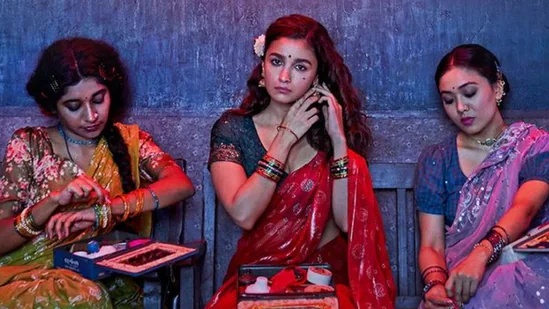
The basis for the film is the 2nd chapter, ‘The Matriarch of Kamathipura’ in the book‘Mafia Queens of Mumbai’ (2011) by Hussain Zaidi, author and investigative journalist, also credited with writing several popular books on Bombay’s Underworld. The story of Gangubai Kathiawadi’s entry into this profession is almost similar to all those stories where innocent, helpless girls are sold into the brothels after being lured into false promises of marriage or work. Gangubai belonged to an affluent family and is shown to have a deep desire to act in films, especially opposite Dev Anand, a reference used at subtle and strategic scenes in the film. After eloping on the pretext of working in films with an acquaintance named Ramnik Laal, who also became her husband for a while (an aspect skipped in the film), she found herself sold at a brothel in Kamathipura. It is gruesome and tragic to see women being shoved into prostitution through their closest acquaintances more often than not. Here thus, Gangubai too parallels the life of a typical sex worker, beginning with being duped by a lover or acquaintance and then forced into the profession by torture, physical and mental. This, keeping in mind the times, context and taboo associated with sex work, (even to this day ironically), it was forbidden to return home in those circumstances. In this case, more so, despite from an elite traditional Gujarati family- the concept of shame, purity- polluted and respectability holding primacy over forgiveness, acceptance and reconciliation. But such is the tensile nature of human mind and body, so much, so that, not only Gangu finally gives in and gives up bowing down to the demands of the new compulsive ‘profession’, dependent onto the mercy of the stranger-customers each night, that the character is shown to be subjected to the physical and mental torment in every possible cruel some way.
Gangubai – The Inspiring Journey or the Selective Cinematic Liberty?
While the film closely aligns with the realistic depiction as mentioned in the book, however, surprisingly, the film does not embrace the book in its entirety. In his book, Zaidi narrates Gangubai’s life in great detail, covering important events, which opens up multiple layers of her life and personality. On the contrary, the film cautiously takes a safer one-dimensional character, a story akin to a ‘phoenix’ who is shown charting her way out of every struggle thrown at her – ‘rising from the ashes’. The director may have consciously omitted aspects in the film, which could have perhaps shown her in a more realistic light. Despite all its cinematic and acting strengths, the film falls short to show the nuances of Gangubai’s character- her social and psychological contexts. The excellent casting, acting and cinematography do succeed in creating a larger-than-life persona on the screen, but one wishes to fathom her struggle, challenges or her inner psychological strains in achieving such fame. The director has adopted the original plot of the book only partially, perhaps either due to the constraints of the very form of the storytelling, which has to be short and crisp or may be due to the sheer demands of the commercial cinema. But the film must be given credit for the fact that it gives Gangubai a form, visibility, a kind of personification in our imagination. Sometimes, a chapter in a book might not reach or range itself to an extent as much viewing it on a visual medium, and if we have popular mainstream cinema makers and actors playing its part, it makes it even more impactful.
Gangubai – The Prostitute or the Protector of Prostitutes?
In India, Prostitution is neither illegal nor does the Indian laws regulate sex work. However, it is the organisations of the brothels that are considered illegal, and are therefore banned. Informally, excesses meted out by local police under the pretext of safeguarding, and routine raids is not an unknown phenomenon, an aspect also dealt sensitively in the film.
While a 2007 report of the Ministry of Women and Child Welfare, mentions about 3 million women in India being engaged, the 2016-18 survey of UNAIDS projects 6.5 lakh sex workers, a term which in itself is an overt generalisation and problematic. Rohini Sahni, in her introduction in ‘Prostitution and Beyond: An Analysis of Sex Workers in India’ (2008), opines, ‘the use of the term ‘sex work’ is a linguistic homogenization that does not do justice to the individuality of different practices of prostitution that have come to survive in India today. NGO Sanlap, attributes economic reasons as the prime cause of the same, with most of them being either forced or worse succumbing with the burden of domestic necessity, the breakdown of marriage or abandonment by their families.
Prostitution, as the oldest occupation of our civilization, has found references in Rigveda, (Sukumari Bhattacharjee in her article, ‘Prostitution in ancient India’). Though, as a profession, it finds space in the literature after Vedas, it has been prevalent in society much earlier. It got institutionalised with the steady advancement in the economic status of the society and the coming up of urban centres along the trade routes, with various names given to the women indulged in prostitution. While Vedas mentions Hasra (frivolous), Sadharani (common woman) and Pumscali (who walks with men); Kamasutra mentions Kumbhadasi and Paricharika (maidservants who could also be enjoyed at will) later, Rupajiva and Ganika (courtesans with different social ranks); in Mahajanpadas periods, comes the term, Janpad Kalyani, NagarVadhu; in Buddhist texts,we find terms such as Salabhanjika. Later it was recognized in the name of the Dev-vesya or Devadasi tradition, and further in the medieval period as a court dancer. As historian Shadab Bano argues that during the medieval era, a woman had to recognise herself as a prostitute and the state recognised a professional prostitute as a full person. She further explains, ‘interestingly, there appear no religious or ethical issues raised against prostitution, and no attempts by the state to prohibit it, as prostitution was regarded as a safeguard against the passions of unruly men’. Mughal official sources similarly bring out the category of singing and dancing girls and ‘make distinctions between the other women who prostituted-the high courtesans and the ordinary prostitutes. It was later by the British regime that these forms of entertainment were regarded as signs of sexual depravity in the natives.’ They brought the term ‘Nautch girl’ for these performers and transformed them into a detestable category whose performance began to be considered amorous and vulgar. The whole exercise of the Census clubbed all these categories into a single category of prostitutes.
In this pretext, as often literature is regarded as the mirror of representing the society of its time, the presence of prostitutes has been asserted across era, with substantial representation and references. Be it Vasantasena, the famous courtesan of Ujjayini in Mrichchakatikam (Shudraka), Amrapali in Acharya Chatursen Sastri’s work Vaishali ki Nagarvadhu, or Divya, the heroine of Yashapal’s Divya who ultimately chooses the life of a prostitute, the presence of ‘this’ community in literature is a testament to the fact that though it connotes an institutionalized presence yet has been subjected to an uncomfortable acknowledgement and validation into the normative fold of Indian culture. One then has to contextualise today’s modern red-light areas against this stream. These erstwhile tawaifs were considered to be heights of tahzeeb and propriety. Mayank Austin Sufi in his book Nobody Can Love You More, writes that “People from high castes and rich families sent their sons to tawaifs or courtesans so that they could learn etiquette”. The real factor behind confining and limiting this profession only to the flesh trade was the British rule, which started using these traditional dancers as the masquerade for the entertainment and gratification of their army. Women began to be imported from nearby villages, and thus in the modern era the tawaifs, or royal dancers, which were once considered a major accompaniment of art and culture, got reduced to a mere instrument of carnal appeasement.
It’s striking how Gangubai Kathiawadi, an ordinary prostitute, to begin with, goes on to become a legend of sorts in her lifetime. It’s astonishing to see how she has been revered much as a deity in her own community. She may have been the only prostitute who first demanded to legalize prostitution by voicing her concerns with the Prime Minister of the day. However, the story of her meeting with Prime Minister Nehru, can be questioned, as Zaidi writes in his book -“Many incidents related to Gangubai have not been written anywhere nor is there any existing evidence to confirm its authenticity. The credibility of these events can be weighed only by oral evidence, the witness of these events can only be confirmed by people. can only be understood by the words of the people, in which these stories have been transferred to this entire community for the last four decades only by speaking and listening”.
Whatever be the case, it’s evident that Gangubai was trying to provide a leader or a voice to these neglected women who were destined to be living on the margins, to women who were treated as mere flesh without soul. She talks about the rights of these women and their children as well, as it’s these children whose future is absolutely bleak in these dark alleys.
Documentary photographer Zana Briskey’s 2004 documentary Born into Brothels, which also won the Academy Awards, tackles this sensitive issue. It is set in the murky and congested lanes of the Sonagachi red light area of Calcutta, which poignantly showcases the tragic present and bleak future of the children born in these brothels. ‘Are these children also doomed to live out the destiny of their mother? Do they not have the right to education or to health or simply to a worry-free childhood? As the income of the women working in these brothels is not enough to get their children admitted to private schools and even if the money is arranged, these so-called schools are often reserved for the elite classes, refuse to admit these children’.
Bhansali has also raised this issue in the film. When Gangubai goes to get her children admitted to a missionary school in the neighbourhood, the father of the school asks even if they put the name of Ganugubai in the place of the mother of these children, what name would be written in place of their father? Gangubai hits back with a raw criticism in her voice – ‘is the name of the child’s mother, not enough?’ The question truly hints at the unsaid hold, bias and conservative notions of patriarchy on our societies. Incidentally, in any case, these children are admitted, but the very next day they are thrown out of the school premises on moral grounds, thus blowing away the dream of a ‘welfare Indian state’ for all to get equal opportunities for education and development.
Adding on, while the role of an external factor is significant in creating a dialogue about a minority or marginalized community in awakening consciousness, but if the consciousness for their rights comes from the within or from amongst them, it yields a long-lasting impact. The importance of this must be acknowledged in the context of Gangubai because it is not only her consciousness for human rights that propelled her to speak about the rights of women of Kamathipura but having a sensitivity and heart of a mother to these wretched prostitutes. Gangubai’s affection and concern for these women were accepted unanimously by almost all the prostitutes of this community.
Renowned journalist Abid Surti’s book, first published in Gujarati as ‘Vaskasajja’ in 1979 and then a reprint in English as ‘Cages: Love and Vengeance in a Red-Light District’ in 2021, tells the story of the streets of Kamathipura. Surti witnesses the story of these infamous streets through prostitute Kumud as the main protagonist, having met her in the later years of her lifewhile he was struggling as a script-writer in the Film Industry. In the book, Surti casts an interesting eye on Gangubai through his protagonist, which authenticates the aforementioned claim. In Kumud’s own words:
“Every Diwali, Gangubai used to order 200 saris. Of these, 150 saris were for the girls of her house and the rest for all the prostitutes she knew but who had now gone to work elsewhere. She hardly forgot anyone. She was more than a mother. In these 14 streets of Kamathipura, where there was no God, Gangubai was the only divine intervention that runs the lives and destinies of these lanes”.
The concoction of power and generosity created such an aura of Gangubai that she became a true power to reckon with. The representatives of every political party needed her cooperation because it was, she who controlled the votes of this part of Mumbai. She was equally popular among the opposing factions of the underworld mafia running in this area. Though there were the ones who ruled in their areas, the balance of power remained in the hands of Gangu.
To understand any community closely, it is necessary to be among them, a time-tested method used in anthropology to study the communities. Probably this is the reason why one has to go among them to understand the lives and struggles of these prostitute women. The way Abid Surti is able to write a true story is only after meeting Kumud. Mayank Austin Sufi is able to study the prostitutes living in Delhi’s GB Road only by visiting their homes frequently and observing silently. In Bhansali’s film also, journalist Faizi goes to Kamatipura and works among them to raise their rightful demands to the public. The character, therefore, serves rightly to give a journalistic authenticity to the film.
The precursors of Gangubai Kathawadi – A departure?
The film Gangubai Kathiawadi leaves its imprints on the note of cinematic experience, but the real contribution of this film should be recognized for bringing the hidden world of prostitution or sex work from the dark pits into the daylight. It’s something that makes us uncomfortable. We all know the presence of this profession but are too cramped in our minds to actually acknowledge their existence as human beings first. It is not for the first time that this tragic world of these women has been made the basis of a cinema. Prostitutes have previously been featured on screen in commercial films such as Pakeezah, Umrao Jaan and art films such as Kali Shalwar, Bazaar, Chandni Baar and many more. In Pakeezah and Umrao Jaan, although the basis of the story is fiction, their world is depicted with a medieval sensibility, where these tawaifs used to be more famous for their skill and art. These films were representatives of the previous generation of prostitutes, who were an essential part of a feudal system, where the entertainment or pleasure of their company was available only to the upper classes. Both Meena Kumari in Pakeezah and Rekha in Umrao Jaan perform dance and music in front of the feudal Nawabs, which signifies their exclusivity in terms of representation as they cater to a certain class. Though they may be performing in a different setting, the destinies and experiences of these women had a commonality. For instance, Umrao, who is kidnapped and sold to a brothel, due to the mutual enmity of the families in his childhood, keeps on sobbing for the lost childhood. In the end, the poignancy with which she meets her ageing mother shows how the intensity of human relations never fades. Similarly, in Pakeezah, Meena Kumari, who is doomed to return to the brothel as a tawaif after the death of her prostitute mother, rejects the hero’s true love as she views herself as essentially a prostitute and thus a fallen one. Though these films depict the life of courtesans and prostitutes, they are marred with sentimentality and romanticism, which makes them nothing but ‘damsel in distress waiting hopelessly for their rescuers.
The art cinema, however, has shown a more realistic depiction of the forbidden world of prostitutes without having been indulged in overt sentimentality. The film Kali Salwar based on Saadat Hasan Manto’s story brings to the fore the naked reality of this world through the protagonist Sultana, while Sagar Sarhadi, in Bazaar, demonstrates the compromises made by women in this profession through Najma, who was shown to face the danger of playing nothing but a mere puppet in the face of male domination of society.
In this case, however, one wonders if Gangu could have been shown to meet the lover-turned devil, who ruthlessly sold her, or the continued support of Lala that ably assisted her to continue as the elected representative of Kamathipura in subsequent decades. Likewise, the scene of indifference on the telephonic conversation with her mother, decades after leaving the house, the ache with which most of her inmates discusses of that regret where they left home, without consent of their parents are all aspects that leave a scar in the minds of viewers, with some of the ‘if only’ in an otherwise dark and dejected lifetime of Gangubai.
While the films prior to Gangubai Kathiawadi, used fiction as a narrative drawn from the real-life narratives, the latter is an important addition to Indian Cinema to reel the tragic life of Gangubai, a name that is well recognised, documented and identified even to this day. While Zaidi’s Chapter (Matriarch of Kamathipura) may not have been taken into adaptation in entirety, what is commendable is that we are left with some soul-searching amidst the glamourised cinematic world of Bhansali’s film with some of the haunting melodies, white costumes and magnanimous sets of the 128-minute film.
The rights of many Gangubai, in today’s context:
Though Prostitution is illegal in India and the laws regarding it dictate that one cannot openly do the profession of prostitution in public view, there are no laws that make way for complete eradication of this so-called evil of our society and talks about providing alternatives of profession and opportunities for these women engaged in this profession. The State is silent when it comes to sex workers and somehow an alternative arrangement has been made to do it covertly, and this is the reason why sex workers organize themselves in all those areas and shanty corners and transforms themselves into a ghettoised community, fated to live a doomed life. Kamathipura in Mumbai, Sonagachi in Calcutta, G.B. Road in Delhi, Majestic in Bangalore, Reshampura in Gwalior, Kabadi bazar of Meerut are examples of such doomed generations, whose existence isn’t quite seen with the skylines of these big cities.
Therefore, it is essential that by accepting the truth of this large population, living far off from the mainstream and having been left behind in the course of development, the State and the civil society make arrangements to give human dignity and protection they deserve so that their future generations remain hopeful for the future. Gangubai’s dialogue in the film addressed to our first Prime Minister, Jawaharlal, wrenchingly written by the great Sahir Ludhianvi; one wonders hold equal and higher prominence even to this day then?
“Eve’s daughter wants help
Yashoda’s kin, Radha’s daughter
Ummah of Payambar, daughter of Zulekhan
Where are those who are proud of Hind?
Where is it? Where is it? Where is it?”





 ज़िन्दगीनामा
Leave a comment