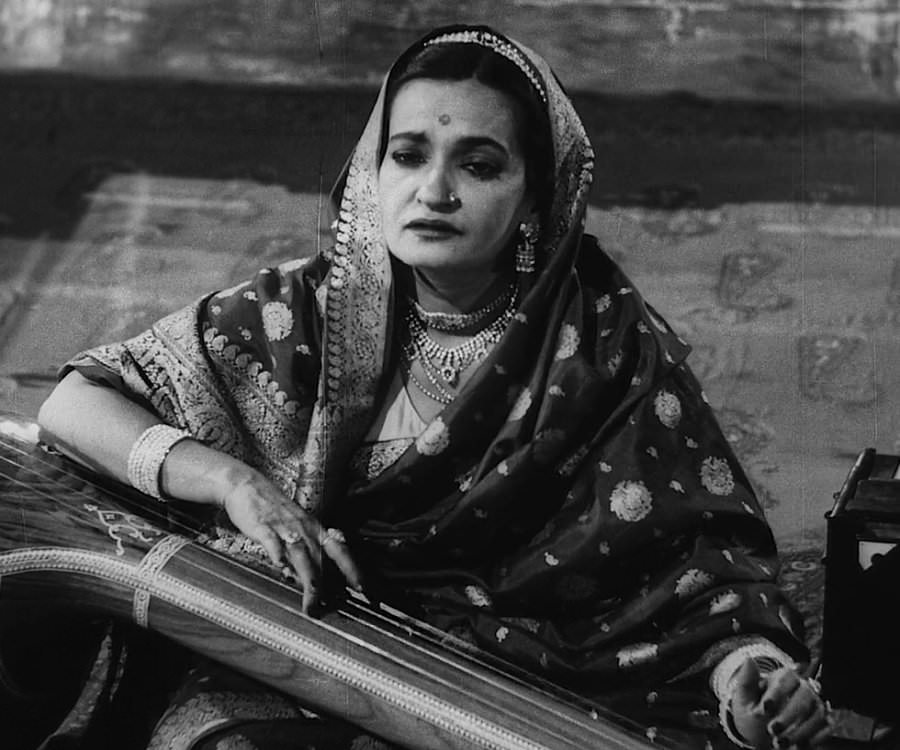
Among the girya-o-zari form of theme/expression, the ghazal, which best symbolizes, lamenting/wailing over the separation from the beloved, is undisputedly, the Shakeel Badayuni’s immortal piece, sung by Akhtari Faizabadi, – Ae Mohabbat tere anjaam pe rona aya.
:format(jpeg):mode_rgb():quality(90)/discogs-images/R-12572562-1537855335-6925.jpeg.jpg)
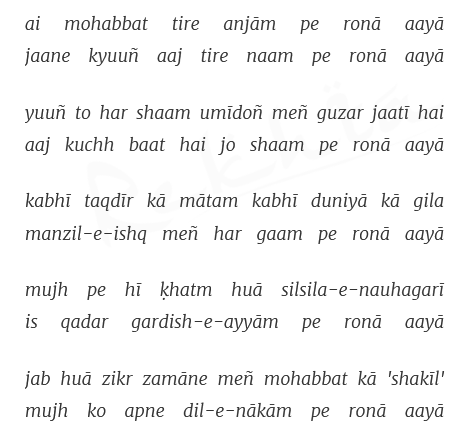
The enchanting voice and the words:
As Peter Manuel, in “A Historical Survey of the Urdu G̱azal-Song in India“, in Journal of Asian Music, 1988-89, Vol. 20, No. 1, pp. 93-113, mentions – “the light-classical gazal genre was dominated above all by Begum Akhtar (d. 1974), who brought the style an unprecedented sophistication and respectability. Partially under her influence, the archaic virtuoso approach to gazal of the previous generation passed out of vogue; the modern gazal, as popularized by Begum Akhtar and others, stresses effective text elaboration in moderate to slow tempi rather than displays of technical acrobatics””.
Four decades after her death in 1974, she continues to be heard and rule the hearts of generations of music listeners, across South Asia, beholden to her art and talent, thanks to her soulful music and grace personified. A well-known classical vocalist Neela Bhagwat, on not missing a single concert of Akhtari Bai, once said, “there was magic in her voice. The way she projected words made listeners yearn for the next line.”
Mudgal, while presenting, the inaugural paper on the occasion of a seminar celebrating Begum Akhtar organised by National Council for Performing Arts, in 2015, said:
”The genius and distinctive artistry of celebrated musicians is best experienced through their work. Music speaks for itself, touching and moving the hearts of listeners in ways that sound trite if verbalized, but for the student of music, not only is the genius of an artiste to be experienced and enjoyed but also studied, examined and re-examined in minute detail. It is with the dual purpose of providing the opportunity to both experience and study the magic of Begum Akhtar’s unique voice and singing style”, that we must delineate or look back at her renditions. For, if there is a voice that defined pathos, dard, deepness, gehraai, technique, taiyyari, she was definitely somewhere on top, globally.
Dr Aneesh Pradhan, appropriately resonated, alike with remarks, that he was ”certain that no performance by present-day singers presenting songs immortalised by Begum Akhtar would do adequate justice“, and how he and Shubha Mudgal, ”felt a crying need for serious analysis to understand and learn from her experience and artistry; to discuss and analyse her music, the legacy she passed on, the manner in which her work impacted contemporary ghazal singers and their gayaki, her perspective on Urdu poetry, among other areas of inquiry.” She added, “in the absence of this, one often encounters attempts at cloning these maestros. Needless to say, such attempts howsoever well-intentioned, pale into insignificance.”
Against this backdrop, this post attempts to reflect back onto this, popular, timeless, immortalized, soothing rendition of Akhtar, from 1930s. It is to the credit of ”superlative creative confluence” of the duo- Shakeel Badayuni and Akhtar, so effectively, that any listener will find an obvious affinity to the sentiment of the ghazal, while the popularity of this recording serves to illustrate how verse and composition, can constitute an effective outcome, to this extent. (Different sources quote different names as the composer, including Murli Manohar Swarup).
The setting, in dadra tal, is typical of the light-classical style of its period. ”Its formal structure is that of the sthayi-antara pattern outlined above, with the antara (“yun to… thi”) sung in a higher range,
in a more free-rhythmic inprovisational style. The melody does not conform to any particular rag. There are no fast virtuoso tan, although the melisma on “thi” is notable.”
Anecdotally, poet Shakeel Badayuni, is said to have given this ghazal to Begum, on a station, as she was about to embark on a journey to Lucknow. She on glancing it, asked for her harmonium is said to have composed it, before reaching the destination, recording it for AIR Lucknow, in early 1950’s. little did they know, that it was to be regarded as one of her most iconic ghazals, decades later. Begum Akhtar’s achingly beautiful voice with its expressive yearning, spreads out the words, maintaining the dignified restraint typical of her melancholy form and style of presentation.
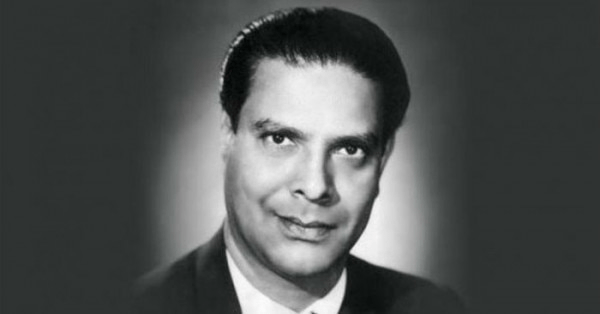
Akhtar- Badayuni collaborations also gave us, “Har jafaa har sitam gavaara hai, Itnaa keh do ke tu hamara hai”, ”Mere humnafas, mere humnawa, mujhe dost banke daga na de” among many. One also wonders, if Sahir Ludhianvi’s ”Kabhi khud pe kabhi haalat pe rona aya”(Hum Dono, 1961) was inspired from this song?
The ghazal, rendered in various concerts goes as:
ऐ मोहब्बत तेरे अंजाम पे रोना आया
जाने क्यों आज तेरे नाम पे रोना आया
(O love, I wept over your conclusion;
I don’t know why I wept over your name today)
यूँ तो हर शाम उम्मीदों में गुज़र जाती थी
आज कुछ बात है जो शाम पे रोना आया
(Like this I used to spend every evening in my hopes;
Today there was something that made me weep)
कभी तक़्दीर का मातम कभी दुनिया का गिला
मंज़िल-ए-इश्क़ में हर गाम पे रोना आया
मुझ पे ही ख़त्म हुआ सिलसिला-ए-नौहागरी इस क़दर गर्दिश-ए-अय्याम पे रोना आया
जब हुआ ज़िक्र ज़माने में मोहब्बत का ‘शकील’
मुझ को अपने दिल-ए-नाकाम पे रोना आया
Additionally,
जो मुझे तुमने दिया, और मेरे हाथों से गिरा,
साक़िया मुझको उसी जाम पे रोना आया।
It is indeed, difficult to separate, this captivating ghazal(a platinum disc), and the singer, in this case.
If 1925 saw Akhtaribai arrive as a ghazal singer through Behzad Lakhnavi’s ‘Deewana Banana hai to deewana bana de, warna kahin taqdeer tamasha na bana de‘, 1951-52, through this ghazal, rightly consolidated her as the Mallika-e-Ghazal for her admirers, connoisseurs of ghazals alike and also generations of singers.
Akhtar, often sang this piece/composition multiple times on request of her audience in the same concert, each time giving it a different treatment to her rendition, making a spellbound impact on her audience. Likewise, Akhtar, is credited to have translated this ghazal( with simple words), into the an absolute melody, through Raag Bhairavi, conveying that pathos, through ‘rona aaya’.
In the article Amazing grace, Pankaj Udhas says, ”this ghazal, which is grace personified, influenced me a lot in my singing career. Right from the control of the poem to delving into its delicate notes, Begum weaved a complicated web with her voice.” Further, he adds, to ‘have sung it a number of times in my own concerts including an annual concert series called ‘Khazana’ where all the ghazal singers of the country offered a tribute to Begum. But no singer can generate the mystical aura that just an old LP of hers can create. She will always remain a true Mallika-e-Ghazal for me.”
In 2008, one of Akhtar’s student, Rita Ganguly, gave then a logical extended tribute to her ”ámmi”, through a book titled, Ae Mohabbat… Reminiscing Begum Akhtar. Such was the legacy of this ghazal.
See, the same composition being sung by her enchantingly, with slight alterations and musical variations, beginning with the legend introducing herself, at 1.08 to 2.15 second in the documentary by Rajya Sabha, where she sings Ae mohabbat, perhaps at her best;
Also see,
Also see, various version(s), closely aligned to the original version retaining the essence, to a large extent;
II
Ustad Barkat Ali Khan (1905-1963), a classical vocalist from Patiala Gharana, was the son of Ali Baksh Kasuri and younger brother of Ustad Bade Ghulam Ali Khan. His style of singing Raag Pahadi is said to have influenced a whole generation of thumri and ghazal singers, including Farida Khanum and Ghulam Ali.
A related, although distinctive approach to gazal was introduced by Barkat Ali Khan and his style was characterized by a ‘profusion of lush melismatic ornamentation‘; technically, his style is much more demanding than the mainstream purab (eastern-i.e., eastern Gangetic plain) style of Begum Akhtar and others; perhaps for this reason, few singers today even attempt to duplicate his style.
Here is his perhaps an earlier version of this immortal rendition, with jewel-like intricacies, each detail perfectly executed. Noteworthy, is, as Amit Chaudhuri mentions of him and his calm form singing, “a sort of saturated timbre of the voice becomes everything, and we return with it to the basic principle of listening: to the inexplicable yearning of sur, or tone, or melody, without distraction“.
III
A contemporary rendition without losing connect to its original essence, again is by Ustad Raza Ali Khan, the grandson of the legendary Ustad Bade Ghulam Ali Khan of the ‘Kasur Gharana’, the celebrated classical singer; As expressed, this version attempted at a rendition of this iconic ghazal, in a way to connect with the new generation, while keeping the authenticity intact.
IV
Finally, this rendition by Pandit Ajay Pohankar, is a fine and delicate fusing of two of Badayuni-Akhtar collaboration, Mere humnafas mere humnawa, with Ae Mohabbat tere anjaam, beautifully.
For all her admirers, as Shabana Azmi, once said, “Like the brilliance of the diamond in her nose stud which flashed from the stage, her music touched every single soul present. How couldn’t I be gripped?”
In the end, for Akhtar, the lines, from this ghazal, aptly resonates,
‘Jaane kyun aaj, haye
Jaane kyun aaj tere naam pe rona aaya‘;




 ज़िन्दगीनामा
Leave a comment