About Pritam:
I
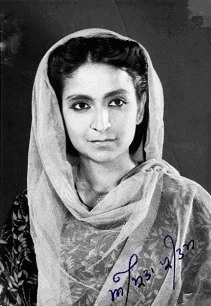
Source: http://theprg.co.uk/2008/08/
Amrita Pritam, (31 August 1919 – 31 October 2005) was one of the first prominent female Punjabi poet, who wrote extensively in Punjabi and Hindi.
Across seven decades, she wrote poetry, fiction, essays, auto-biography, collection of folk songs in Punjabi, prose and travelogues. Her rich literary corpus includes publication of over 75 books – which includes 28 novels, 18 volumes of verse, five short stories, and 16 miscellaneous prose. For two of her novels, Dharti Sagar te Sippiyan (1965) and Unah Di Kahani (1976) that have been made into films entitled “Kadambari” and “Daaku,” she even composed songs.
She had also published autobiographies, titled, Kala Gulab (“Black Rose”, 1968), Rasidi Ticket (“The Revenue Stamp”, 1976), and Aksharon kay Saayee (“Shadows of Words”). Ironically, Rasidi Ticket was banned by Punjabi University, Patiala.
She edited Nagmani, a monthly literary magazine in Punjabi for several years, which she ran together with Imroz, for 33 years (1966-2003);
She was the first woman to win Sahitya Akademi award for her magnum opus, long poem, Sunehade, in 1956. She also received, Jnanpith Award in 1982, for Kagaz Te Canvas; Apart from this, she recieved Padma Sri in 1969; Padma Vibhushan in 2004; Sahitya Akademi Fellowship (India’s highest literary award) in 2004. In addition, she also received the International Vaptsarov Award from the Republic of Bulgaria (1979) and Degree of Officer dens, Ordre des Arts et des Lettres from France (1987).
Amrita Pritam’s institutional influence on Punjabi literature has been laudable. She is a household name in Punjab, being its most prominent woman Punjabi poet and fiction writer. She started writing primarily in Hindi, before switching to her native Punjabi. Be it ‘Amrit Lehan’, ‘Kagaz Te Kanvas’, ‘Sunehray’, ‘Kal Chetna’, ‘Agyat Ka Nimantran’ and in other works, Amrita Pritam never failed to provoke readers with her rebellious thoughts. In contemporary Punjabi literature, Amrita Pritam’s autobiography Rashidi Ticket, “The Revenue Stamp,” was first published in Punjabi.
One of her most renowned work was the poignant elegy and expression of her anguish in wake of Partition related massacres in form of ”Ajj aakhaan Waris Shah nu” (“Ode to Waris Shah”). This theme saw its poignant extension in form of a novel, Pinjar(1950) which was also adapted into a film in 2003, a wrenching portrayal of the agony of communal riots, abduction and its assosciated trauma.
Pritam migrated from Lahore to India, after the Partition, in 1947. Aankhaan Waris Shah Nu …(‘Ode to Waris Shah’), beautifully, captured this mayhem, and this was a call to the legendary Waris Shah (1722-1798) with whom she shared her birthplace, Gujranwala!
‘Today, I call Waris Shah, ‘Speak from your grave’. And add a new affectionate page to your book of love
Once, one daughter of Punjab wept and you wrote a wailing saga.Today a million daughters weep, calling to you, Waris Shah
Rise! O’ friend of the grieving and afflicted; rise! and see the state of Punjab today,fields are lined with corpses, and blood fills the Chenab; Someone has mixed poison in the five rivers’ flow which now irrigates our lands galore.
And it goes on,
Where can we find another one like Waris Shah?
Waris Shah! I say to you, speak from your grave
And add a new affectionate page to your book of love!’
Amrita’s poem, transcending geographical and communal boundaries, captured the pain of the Partition. ”Undoubtedly this poem carries a burden and load of the people of Punjab and of Pakistan with deep longing and emotional turmoil, both for the separated and the dead for its readers on both sides, alike.”
Source: http://www.languageinindia.com/dec2005/amritapritamsunwani1.html
II
Born as Amrit Kaur in 1919 in Gurjanwala, Punjab, (in present-day Pakistan), She lost her mother at an early age of eleven, after which she and her father moved to Lahore, where she lived till 1947. Her first anthology of poems, Amrit Lehran (“Immortal Waves”) was published in 1936, at age sixteen. She was married to Pritam Singh, an editor, leading to her becoming Amrita Pritam!
1936-1943
From starting as a ”romantic poet”, she became part of Progressive Writer’s Movement, and this was reflected in her collection Lok Peed (“People’s Anguish”, 1944). Pritam also worked at a radio station in Lahore for a brief while too. She till 1961, worked in the Punjabi service of All India Radio, Delhi.
It was only after her divorce in 1960, her work evolved into feminist writings, perhaps drawing from the unhappy experience of her marriage.
III
Retrospectively, when Amrita Pritam, in the course of a conversation with Khushwant Singh, disclosed her plans to write an autobiography, the latter unwittingly remarked: “What is there to your life? Just an incident or two … you could use the back of a revenue stamp to write it.”
In a brief prologue to “The Revenue Stamp,” Amrita Pritam shot back, “Whatever happened in my life happened between the layers of thought that found their way into novels and poems. What was left? Still, I thought I might write a few lines — something to complete the account book of my life and at the end, seal it with this revenue stamp as it were. Or am I with this revenue stamp setting a seal to my novels and poems … my entire, literary work … I wonder.“
Shadows of Words, sequel to her autobiography, capture her life in its varied fold, with Shadows of birth and death, Shadows of weapons, words, dreams, shadows of authoritarian power and shadows of contemplation, an attempt to reflect her inner world.
One of the aspects that was a recurrent theme in her writing was the suppression of women, largely because of their economic dependence. Her poem “Main twarikh han Hind di” (Me, the history of India) almost sums up her literary output. Some of her books are Kagaz Te Canvas, Jai Shri, Doctor Dev, Pinjar, Alhna (nest), Yaatri (traveller), Tehrvan Suraj (the 13th sun), Panj Warhe Lambi Sarak, and Tisri Aurat.
A household name in Punjab, though Amrita Pritam migrated to India, the memories and sufferings she had then experienced always disturbed her. She was deeply troubled by the 2002 Gujarat riots. She wondered in a newspaper interview: ‘why do we humans fight? Can’t we learn something from the flowers? They are all so beautiful but never become jealous of each other.’
Here are some lines from “The Scar”:
I am also of human kind
I am the sign of that injury,
The symbol of that accident,
Which, in the clash of changing times,
Inevitably hit my mother’s forehead.
I am the curse
That lies upon man today.
I came into being
When the stars were falling
When the sun had been quenched
And the moon darkened.
Who can guess
How difficult it is
To nurse barbarity in one’s belly
To consume the body and burn the bones?
I am the fruit of that season
When the berries of Independence came into blossom
Jalte Bujhte Log (2005) is Amrita Pritam’s swan song and contains three novelletes, written earlier: Jalaawatan, Jebkatre, and Kacchi sadak.
For Amrita, behaviour and career are nothing else but achieving expertise in filching money from the other person’s pocket, purse, wallet or handbag. Those who are able to do this to the maximum are recognized as the most successful.
IV
Of defiance, a rebel and a recalcitrant, and a revolutionary:
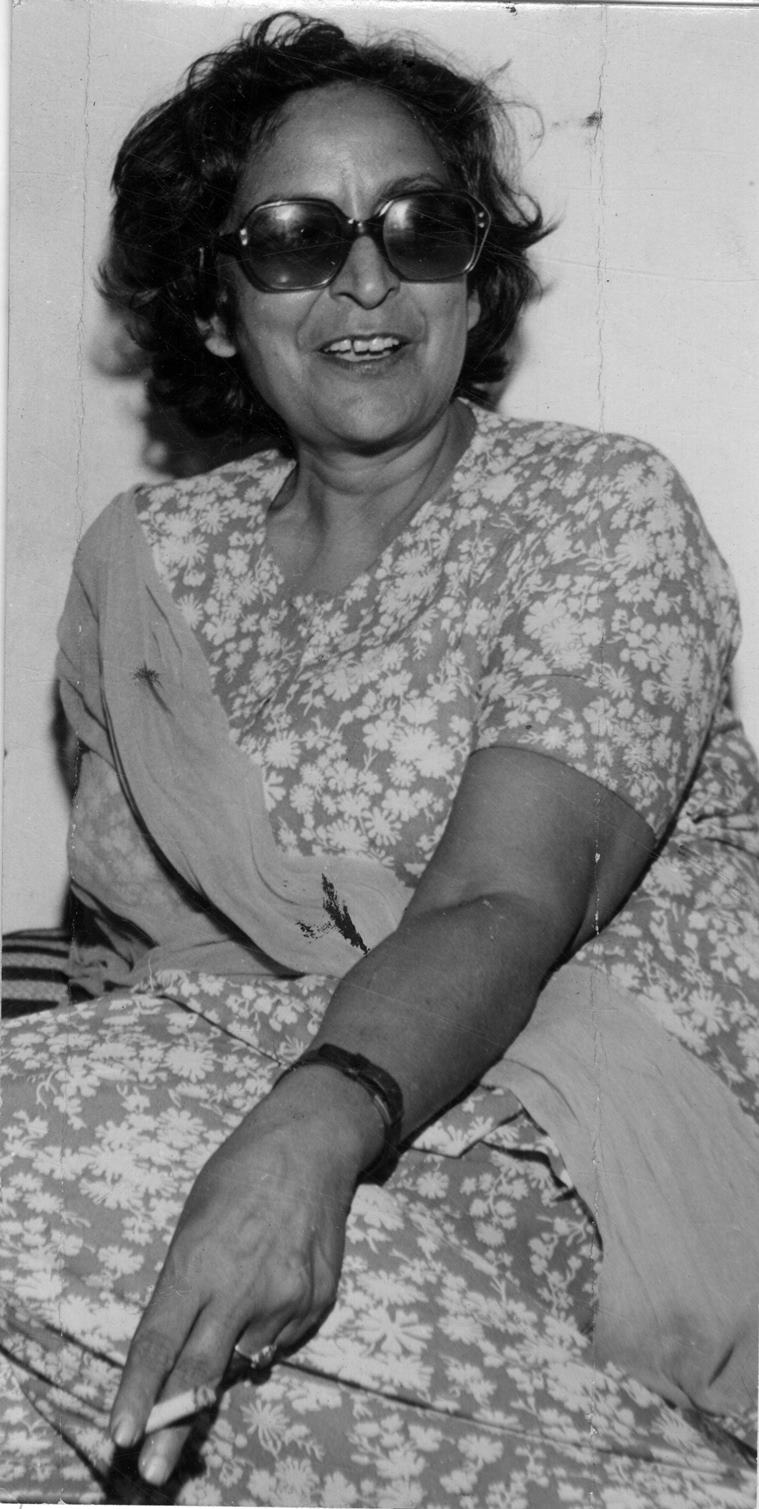
She made no bones about her fondness for the cigarette; one of her last poems referred to it. “Pain, I inhale silently like a cigarette, and a few sons, I flick off like ashes from the cigarette,” she wrote.
Outspoken, prolific and deeply spiritual, Amrita existed within self-defined, non-conformist parameters. She lived with her partner for 41 years, shunned religious and sectarian identities alike:
No absolutes for something as relative as a human life
No rules for something so tender as a heart..
Once Dwivedi dropped by at Amrita’s home and found her laughing with gay abandon. The reason for her mirth was a visit from a journalist who said she wanted to talk about the love in Amrita Pritam’s life. Do you know what Pritam told her?
She said, “I’ve had many loves in my life, which one do you want to talk about?” Imagine the scribe’s audacity that she could dare declare she meant the “Muslim one.” And all Amrita Pritam said in reply was, “Why don’t you first find out the name of the ‘Muslim one’ and then I’d be too happy to talk about my love for him.”
V
On Sahir:
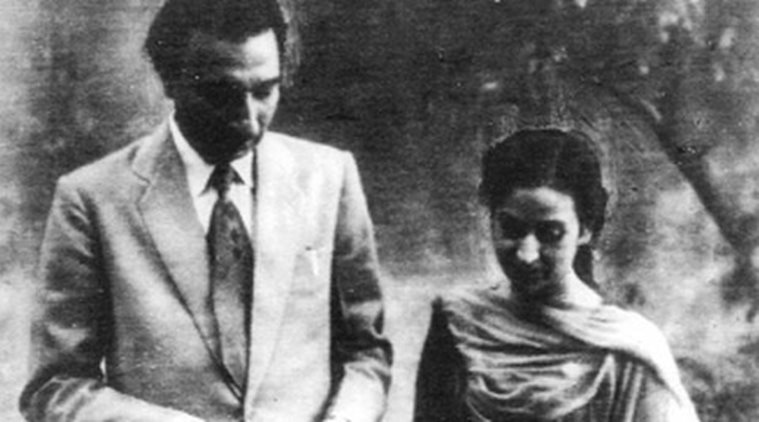
”Muhabbaton ki parakh ka yahi toh rasta hai
Teri talaash mein nikloon, tujhe na paaoon main”
(The best criterion to judge the intensity of love is never to get the person who one loves).
For Pritam to express her feelings for Sahir, her favorite couplet by Mazhar Imam was apt. In fact, in an interview to Hindi magazine Kadambini, Amrita told interviewer Dharmveer Bharti, “Sahir mere Sartre aur main unki Simone thi (Sahir was my Sartre and I was his Simone)”
Said to have a sapiosexual crush on Sahir, she adored him to be the ”qalam ka jaadugar” (wizard of pen).
“In our relationship, I was the more passionate one,” she once said. “My book of poems, titled Sunehre, was full of messages for him. But they did not melt him. However, my love was not wasted. I got the Sahitya Akademi Award for the book.”
A path-breaking writer, Amrita also lived life on her own terms. She fell in love with the poetry of Sahir Ludhianvi and nurtured an infatuation for many years.
”She wrote his name hundreds of times on a sheet of paper while addressing a press conference. They would meet without exchanging a word, Sahir would puff away. After Sahir’s departure, Amrita would smoke the cigarette butts left behind by him. After his death, Amrita said she hoped the air mixed with the smoke of the butts would travel to the other world and meet Sahir! Such was their obsession and intensity.”
Aur mujhe lagta hai –
Ki shamshan ki aag, aag ka apmaan hai
Kisi Sohni, Sassi ya Heer mein –
Jo aag jalti thi
Mujhe us aag ki pehchaan hai
( I feel that the fire of the cremation ghat is an insult to the flame. I recognize the “flame” that burnt in the hearts of any Sohni, Sassi or Heer.)
In the initial days of their courtship, Amrita wrote to Sahir,
“Tumhare darakht ki tahani ka jo aasra mila/Mere toote hue dil ka parinda wahin ruk gaya (When I found the branch of your tree/ The bird of my broken heart perched there permanently)”.
Further, she wrote,
“Main tumhari hokar rah gayee/Tum mera mukammal vajood ban gaye (I became yours/You became my whole existence)”.
Elsewhere, in her last letter to Sahir which she personally handed over to him, she wrote “Maine toot ke pyaar kiya tum se/Kya tumne bhi utna kiya mujh se? (I loved you wholeheartedly/ Did you also love me that much?)”.
While leaving Sahir’s place for the last time, Amrita quoted Byron: “In her first love, woman loves her lover/ In all the others, all she loves is love.” Sahir calmly asked her, “Aap jaane se pahle iska tarjuma kar dengi? (Before leaving, will you please translate it?)”. Amrita wrote in her memoirs that whenever Sahir was not happy with her or sulking, he’d use aap for her instead of tum.
For her legendary love for Sahir, can be felt, like the time her son came to her and said, “People say that I am Sahir Uncle’s son.” Imagine the inner courage and conviction of a woman who could reply, ” I wish you were Sahir Uncle’s son.” While Amrita tells him that his father was Pritam Singh, she also narrates how she used to look at the flower pots in her house and see Sahir’s countenance each time the plants moved. This honest expression of her desire for Sahir was rare!
Their last meeting was very poignant. Pakistani activist and Amrita Pritam’s dear friend, the late Fahmida Riyaz wrote a piece — Amrita ki Sahir se aakhri mulaaqaat: Amrita’s last meeting with Sahir) — in Pakistani Urdu daily Jung. Amrita told her that while parting, Sahir said poetically to her, an This impromptu couplet: Tum chali jaaogi, parchhaiyaan rah jaayengi/Kuchh na kuchh Ishq ki raanaaiyaan rah jaayengi (Fahmida figuratively translated it: When you leave, your lovely silhouettes shall remain/ Memories and traces of love will smart me time and again).
And when Sahir got to know that Amrita found Imroz, he wrote, “Mujhe apni tabahiyon ka koi gham nahin/ Tumne kisi se muhabbat nibaah toh dee (I’m not sad over my losses and ruins/ I’m happy that finally you found someone worth living for)”.
In 1980, Amrita, after getting to know about Sahir’s death, said: ‘Ajj main apne dil de dariya vich, main apne phul pravaahe ne…(Today, in my heart, I have cremated myself too).”
VI
On Imroz:
A contemporary love legend, and in times when love is so rare, much has been written on Amrita and Imroz.
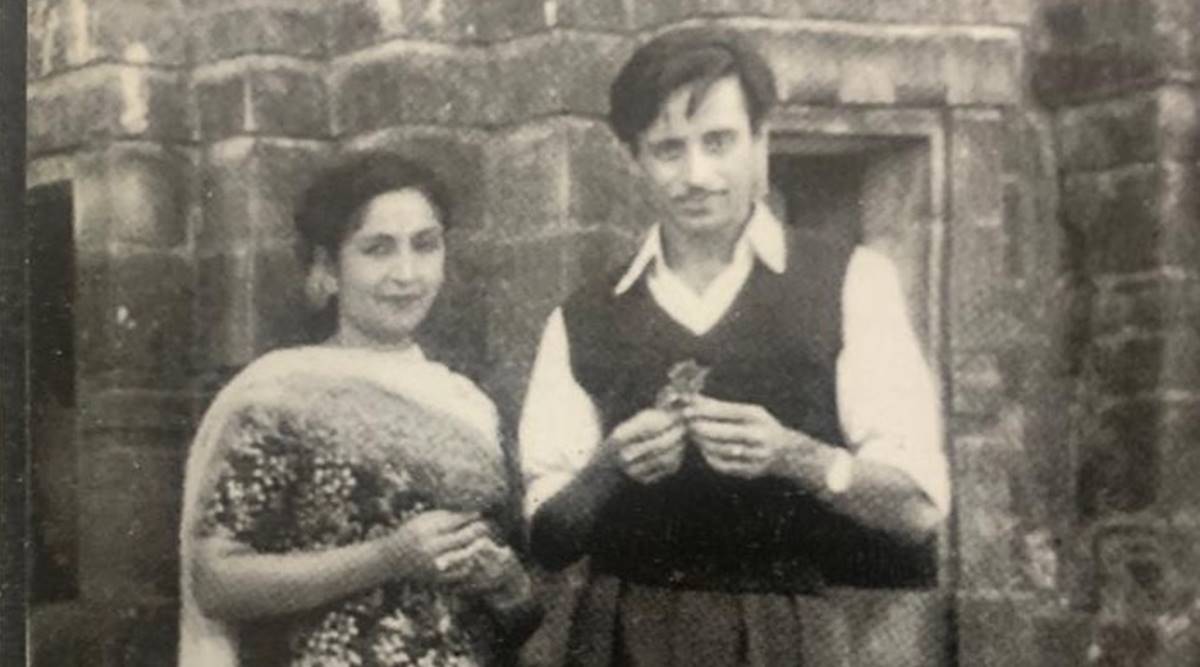
Uma Trilok asked Imroz, “Amrita lived with the memory of Sahir, did it bother you?” Imroz says: “No. I accepted it. There is no hassle when one loves without ego, without argument, without making artificial arrangements, and without calculations.”
The parting, in 2005, captures the chemistry the kindred souls shared: “At the end of the deserted cremation ground, a few people were standing, silently staring at the burning pyre. Away from everybody, alone, standing in a corner, I spotted Imroz. Going close to him and touching his shoulder from behind, I muttered, “Don’t be sad.” Somehow I always felt that Imroz would become very sad after Amrita’s death. He turned, and looking at me, said, “Uma, why be sad? What I could not do, Nature did.”
The two never married, but had a live-in relationship for 40 years. At 94, remembering Amrita on her 101st birth anniversary, Imroz, in 2020 said,
“Wo yahin hai, ghar par hi hai, kahin nahi gayi..”
It was a fascinating relationship of rare understanding, and the companionship lasting over four decades. A man, so much younger than her, with whom she lived in the heart of middle-class Delhi and her children lived in the same apartment complex but a floor below hers.
Yeh mein hoon – yeh tu hai, aur beech mein hai sapna
(This is me and that is you and in the chasm is the dream.)
One of her poems makes the following confession:
”Today I have erased the number of my house
And removed the stain of identity on my street’s forehead
And I have wiped the direction on each road
But if you really want to meet me
Then knock at the doors of every country
Every city, every street
And wherever a glimpse of a free spirit exists
That will be my home” (“Jitthe vi sutantar rooh di jhalak pave, samajhna oh mera ghar hai”)
Suresh Kohli, a critic, on being asked to define who and what Amrita Pritam is, in response to which he responds,
”I laughed and said it is the name of a yatra, a journey, a travelogue of evolution, an odyssey of inner growth . . . there are immense possibilities and various faculties in a human being. And whatever I have written has been an attempt to arouse those submerged feelings.”
Despite her innate humility, Amrita’s last poetic work ‘Main Tainu Pher Milangi’ (I will Meet you Again) in 2004 was for Imroz whom she met in 1957, a befitting vision of her immortality:
I will meet you yet again
How and Where?
I know not
Perhaps I will become a
figment of your imagination
and maybe spreading myself
in a mysterious line
on your canvas
I will keep gazing at you
Perhaps I will become a ray
of sunshine to be
embraced by your colours
I will paint myself on your canvas
I know not how and where
but I will meet you for sure
Maybe I will turn into a spring
and rub the foaming
drops of water on your body
and rest my coolness on
your burning chest
I know nothing else
but that this life
will walk along with me
When the body perishes
all perishes
but the threads of memory
are woven with enduring specs
I will pick these particles
weave the threads
and I will meet you yet again
And on life and death, she wrote,
Kabhi kabhi maut bhi
Jab ek kitab likhti hai
To zindagi se –
Ek bhumika likhwane ke liye aati hai
(Sometimes when death starts writing a book, it beckons life to compose the preface.)
Amrita Pritam, her ideals of humanism and love is alive through her writings, and will continue to remain as an inspiration for those who are non-conformist, rebellious all at the same time.
Also see,
https://www.tribuneindia.com/2006/20061105/spectrum/book4.htm
http://www.languageinindia.com/dec2005/amritapritamsunwani1.html
http://www.littlemag.com/bodypolitic/amritapritam.html
http://apnaorg.com/articles/amrita-biography/



 ज़िन्दगीनामा
Leave a comment